In Adrien Chevalley’s studio in Vevey, certain books are not neatly arranged in his bookcases. They are placed on tables and shelves, lying amongst sketches, molds, prototypes and works in progress. Their covers have been redesigned by the artist—a means of making them his own, expressing a connection felt with their authors and denoting his identification with certain ideas and sensibilities.
Amongst these publications, we find several novels by Ursula K. Le Guin (1929-2018), a major figure of science fiction writing. Her book The Left Hand of Darkness (1969) explores a planet whose inhabitants do not have a fixed gender and uses fiction to explore sexual identity, alterity and the possible means of organizing society in a different manner. The Word for World is Forest (1972), on the other hand, imagines a planet covered with trees, that has been colonized and subjected to intensive exploitation, while contrasting two radically different conceptions of life.
This reading matter doesn’t constitute a literal explanation of Adrien Chevalley’s work; instead, it suggests a shared territory: fiction as a means of changing one’s perspective, an awareness of other forms of life and his profound interest in forestry, ecology, social systems and the co-existence of humans and their environment. Chevalley states that Ursula K. Le Guin allows him to “think of others,” and to view the world from a slightly off-center perspective. This capacity of shifting scale and perspective runs throughout his own work. An insect, a flower, a fungus or a seashell can serve as the starting point for a figure, without us always precisely knowing to which species or genus it belongs.
Strange ceramic objects also appear on the walls and tables of his studio. Adrien Chevalley is captivated by organic forms and their otherworldliness. He is capable of studying an insect at great length and is particularly interested in the transition from the microscopic to the monumental. Something that is almost invisible in real life can become a sculpture, and obvious distinctions between humans, animals and plants disappear with ease.
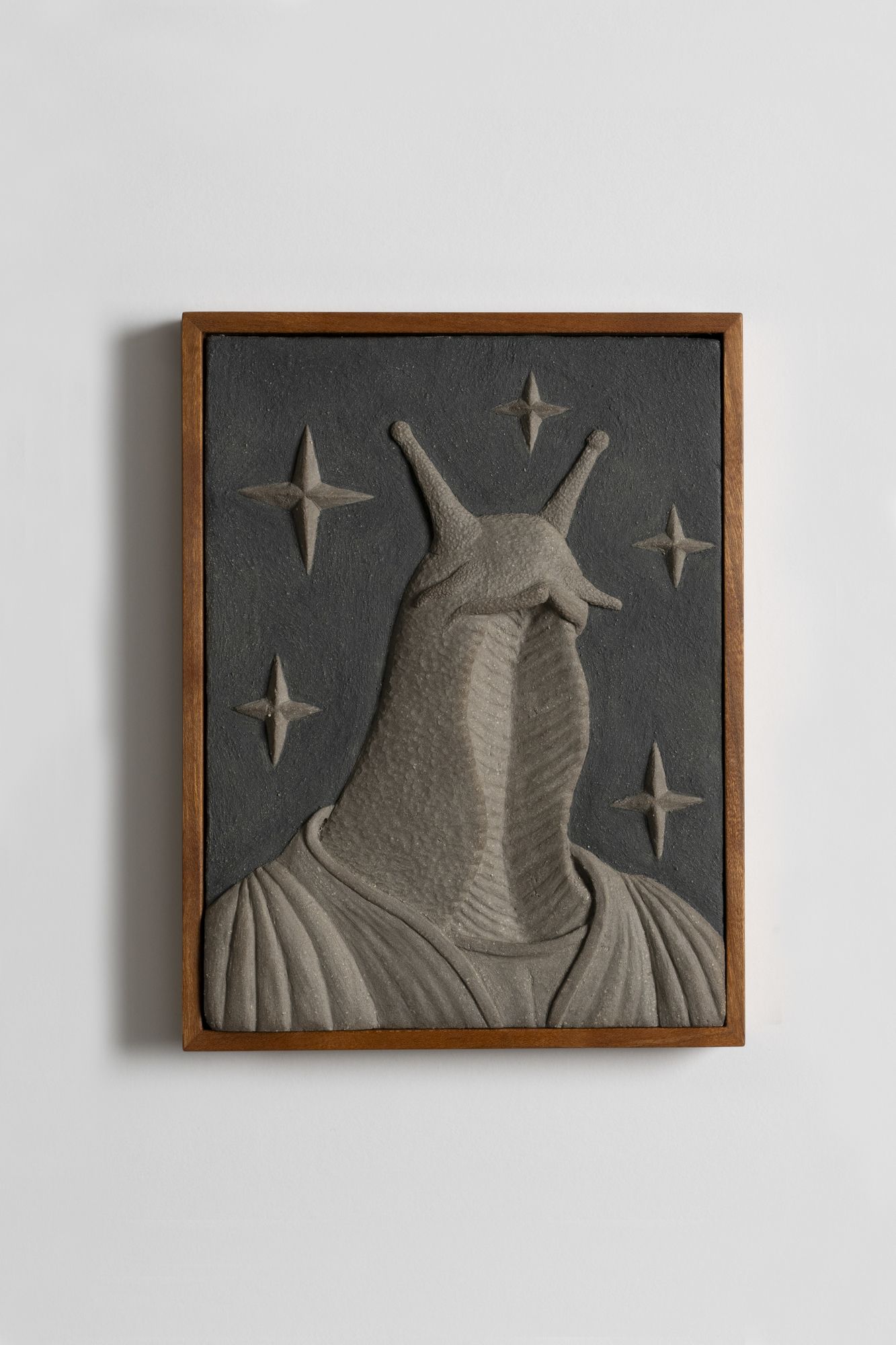
A large part of this material consists of bas-reliefs, a form that has occupied a central place in the artist’s work for several years. During his travels, whenever he comes across examples—in museums, perhaps in stairwells, hallways or on the facades of buildings, that everyday passers-by don’t even notice—Chevalley systematically photographs them. He compiles these black and white photos in small scrapbooks that neither amount to a history of bas-relief nor a scientific inventory, but rather serve as a subjective archive, a kind of repertoire of forms, from which the artist draws inspiration. For example, these booklets feature the large-scale reliefs produced by Alfred Janniot in 1937 entitled La Légende de la Terre and La Légende de la Mer, which he created for the Palais de Tokyo in Paris. A drapery, the curve of a body, an animal, a floral motif, a human figure or an architectural form can be removed from its context, memorized, redrawn and reappear elsewhere, completely transformed. Adrien Chevalley is particularly fascinated by the way a solid material is able to create the illusion of fabric, a body or a pliable object.
Hanging on his studio wall, the visitor can observe a part of his gallery of framed portraits, a project he has been working on for several years. This collection is populated by hybrid figures, some of whose faces have been replaced by plant or animal forms: an individual with the head of a cabbage or the face of a praying mantis, a flower-like body and effigies of snails and cicadas. They are citizens of other worlds who do not appear to have a specifically defined gender.
The artist is particularly interested by bas-reliefs because they withstand any kind of fixed definition. They are not quite pictures and neither are they sculptures, occupying an intermediate realm between two and three dimensions. When photographed head-on, they become almost flat surfaces, whereas when lit from the side, shadows play a role in shifting this practically flat surface into a heavily accentuated volume. Adrien Chevalley delights in describing his own bas-reliefs as a fusion of drawing and ceramics. What counts for him is not so much the sculpting of a volume but its outline: a line that, instead of being drawn with a pencil on paper, is incised, modelled or molded in clay.
This affinity with earth began in Chevalley’s childhood. His parents were potters in a small village in the Swiss Alps and owned a wood-fired kiln. They themselves had been introduced to ceramics by Evelyne Porret and Michel Pastore, who were connected to La Borne, a major center in the revival of French earthenware. In the 1990s, they settled in Tounès, Egypt, at the Fayoum Oasis, where for the local children, they set up a pottery school with a strong social dimension. Adrien Chevalley visited this locality on several occasions with his family and while he doesn’t claim this experience as an artistic lineage and emphasizes that it would be challenging to establish a direct formal connection between these potters and his own work, he does however acknowledge the extent this environment shaped his approach. He also underlines that he doesn’t consider himself as a ceramicist, but that clay allows him to draw, mold, reproduce, construct and above all transform a shape from one state to another.
Molds play an important role in his creative process. Chevalley preserves all sorts of impressions and fragments in his studio—plant matter, found objects and industrial artifacts, for example, all of which constitute sources of inspiration. He is quite capable of casting a vegetable picked from his garden, adding it to an existing form and playfully mocking just how seriously he has created this assemblage. What overwhelmingly interests him is the ambiguity between a shape that appears natural, yet has been cast, and another that might seem machine made, whilst having been shaped by hand.
Among the regularly appearing forms, we find that of the chain. The chain-link is richly symbolic because it evokes a number of contradictory connotations. A chain can enclose a space, mark the boundary of a property, constrain or imprison. It can also connect or bind and even serve as an ornament when used as a piece of jewelry. In certain of Chevalley’s works, a chain-link also serves as a structure from which growths and organic forms spring forth. Thus, this geometric, repetitive, almost industrial shape is gradually invaded by the living.
In his new Paysage (Landscape) series, the artist turns his attention towards the themes of the garden and panoramas. Frameless openwork, these bas-reliefs combine organic forms with more structured elements, evoking grids, fences and garden architecture. Their contours remain irregular and empty spaces separate the various elements, revealing stretches of walling and inviting the compositions into out of frame spaces.
While developing these works, the artist began to take an interest in anthropologist Philippe Descola’s classes at the Collège de France concerning various forms of landscape and his questioning of the Western distinction between nature and culture. He also references Gilles Clément’s Manifeste du Tiers Paysage (2004), which supports the idea of wastelands as neglected and uncared-for spaces where the absence of human intervention allows meaningful biological diversity to flourish. This provides Adrien Chevalley the means of anchoring in reality the questions that, up to this point, only science fiction had allowed him to explore through the use of his imagination.
This relationship with architecture continues with Grimpantes, a series of life-sized sculptures in relief, that stand on the floor and rise up the walls. These structures are based on straight, standardized, mechanically produced rods, to which hand-modeled shapes are added. These modeled forms are inspired by the artist’s observations of vegetable matter—hops, wheat etc.—which are then transformed into hybrid species, reminiscent of the types of plants that grow around the edges of or through the cracks and gaps in slabs of stone.
All of this research however shares an extremely simple starting point: drawing. Despite the pervasive presence of clay, casting and kiln firing, Adrien Chevalley continues to view much of what he does as drawing. For him, drawing does not necessarily entail work carried out on a sheet of paper. It is much more a question of bringing a form into existence, following it and seeing where it leads. There is always a rough sketch or preparatory drawing before the true beginning of a project, whether it is a work of art or an exhibition.
In his exploration of how we perceive our surroundings, the artist readdresses two of the most important genres in the history of art: the portrait and the landscape. The title of the exhibition: Têtebêche captures with humor this interplay between the two genres. “Tête” (head) refers to portraiture, while “bêche” (spade) references the garden or landscapes. At the same time, according to Adrien Chevalley the word also suggests a reversal of perspectives, suggesting “the ground at eye level and the gaze itself turned towards the ground.”
Although these works never present themselves as activist in nature, an attitude of commitment nevertheless emerges: one of envisioning alternative relationships between mankind and the rest of the living world, and one that challenges categories long considered as unshakeable truths, such as those between societies and nature, a subject and its environment or that which dominates and that which is exploited etc. Thus, his work challenges a worldview shaped by the consumption of resources and the pursuit of growth. Without attempting to promote a political agenda, Adrien Chevalley uses fiction and a variety of artistic forms to contemplate alternative ways of existing with the environment that surrounds us. Ultimately, his work suggests that we view the world differently and even imagine that it could quite easily be different.
Nicolas Trembley