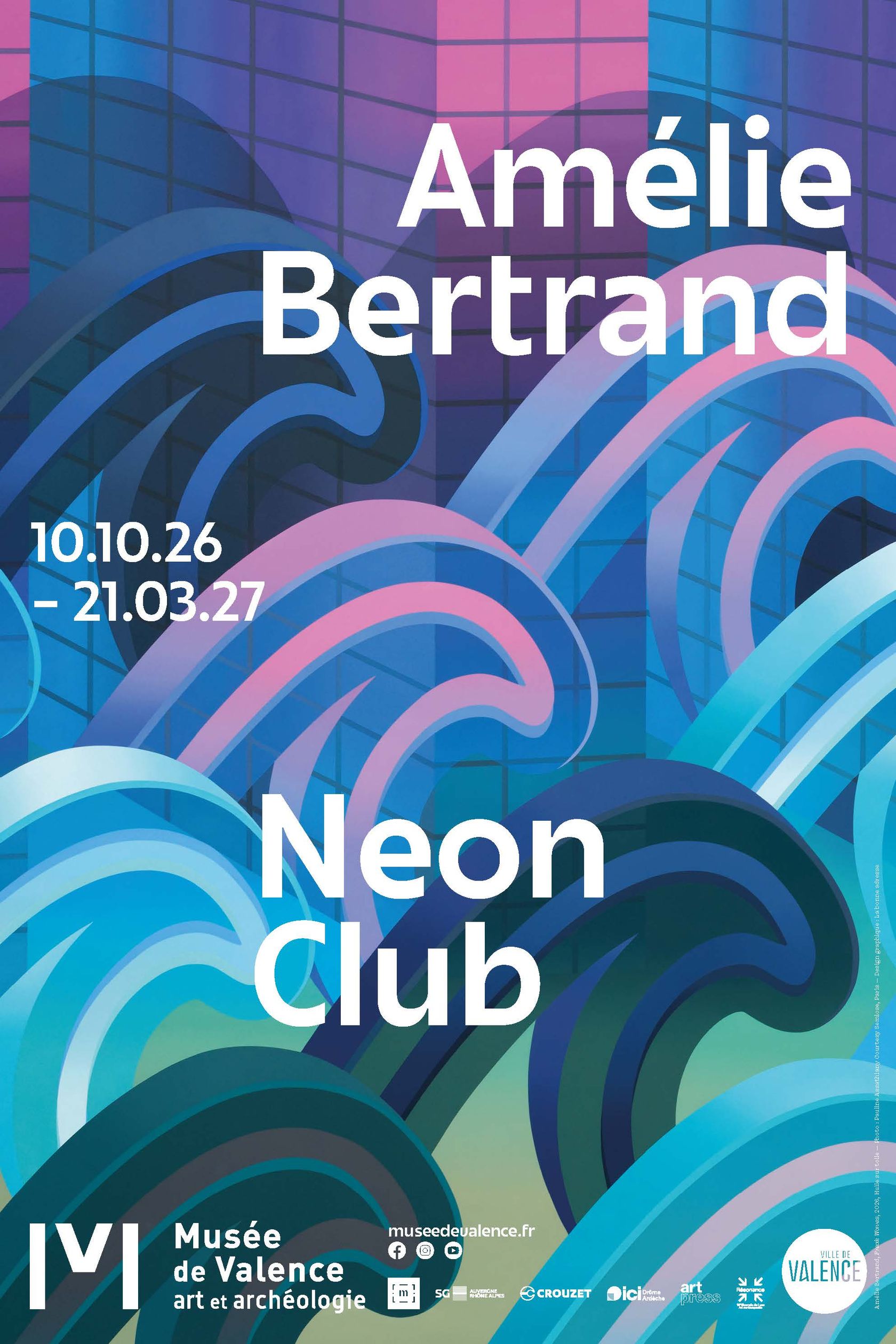
Continuing its program of monographic exhibitions devoted to contemporary artists—including Gerda Steiner & Jörg Lenzlinger (2019), Philippe Favier (2021), Hervé Di Rosa (2022), and Jaume Plensa (2024)—the Musée de Valence reaffirms its commitment to contemporary creation by inviting Amélie Bertrand to develop an original project bringing together recent works, some of which have been influenced by the museum’s architecture and collections.
Through a painting practice defined by a flawlessly smooth finish, Amélie Bertrand (b. 1985) departs from idealized landscapes inspired by nature to construct settings suspended between dream and nightmare. Her compositions are meticulously built from interlocking planes and surfaces that give way to skewed perspectives and depthless horizons. Colors are applied in gradients, always in a single layer, as if suspended on the surface of an impenetrable screen. Within the strict confines of painting, Bertrand creates an atmosphere of déjà vu—a distinctly contemporary climate that is at once psychological and physical. Somewhere between Giotto and West Coast art, she combines the weight of tradition with a synthetic psychedelia, flattening the visual culture of the present into carefully calibrated fields of color and form.
Opening at the Musée de Valence in October 2026, Neon Club brings together approximately thirty works, the majority of them previously unseen and created specifically for the exhibition. The project reveals new directions in Bertrand’s practice and introduces new motifs, including curtains and storefront windows, which expand her established vocabulary of objects and architectural forms. Like the swimming-pool paintings also featured in the exhibition, these new canvases depict liminal or hidden spaces that are as alluring as they are ambiguous.
In the Nightwatchers paintings, “what do the curtains with their subtle gradations conceal?” asks art historian Marjolaine Lévy in her essay for the exhibition catalog. These “watchers of the night,” she suggests, appear to guard the secret of these spaces, populated by signs that lead Bertrand’s painting toward abstraction—an abstraction she continually approaches, yet, by her own admission, never fully masters.
Wave motifs also make their appearance in the exhibition. They join the artist’s growing repertoire of neon signs—lemons foremost among them—which gives the exhibition its title. The monumental canvas Freak Waves (2026) unfurls such waves—or rather, neon waves—across a span of nearly three meters. The exhibition is complemented by works from recent years depicting intense, electric daisies, water lilies, and reeds. Reflecting on the polished finish of these generic images, Marjolaine Lévy describes “a beauty consumed with hyper-artificiality, seductive and indulgent, at once both mythological and digital, where abstraction appears as a form frozen in ice, captured in an instant before it melts.”
Curated by Ingrid Jurzak, Director of the Musée de Valence, Neon Club continues a longstanding dialogue between artist and curator: from Bertrand’s receipt of the Sciences Po Prize for Contemporary Art in 2015, to her decisive encounter in 2023 with Claude Monet’s Water Lilies tondo on view at the Musée de Valence, and through the acquisition of her works by MAC VAL, the contemporary art museum in Vitry-sur-Seine.
Spanning two levels of the Musée de Valence, Neon Club also provides an opportunity for Bertrand to challenge and expand her painting by incorporating the museum’s architecture into the work itself. Thus, the medieval spiral staircase appears in When the Day Is Down (2026), while the motif of the stone wall—a recurring element throughout her oeuvre—takes center stage in The Flower of Carnage (2026). Bertrand extends this permeability between painting and architecture through a subtle scenographic intervention that alters visitors’ perception of the space. A large-scale window installation bathes both the museum façade and the galleries in a pink glow. The work spills into the surrounding architecture, blurring the boundary between real and painted spaces.
Enhanced by a floor projection and a series of arches cut into the gallery walls, the exhibition becomes an immersive environment that envelops visitors and, through a clever reversal, gives them the illusion of moving within the spaces of the paintings themselves—a paradox for an artist whose work is notably devoid of human figures. No longer does only the eye wander freely through painted worlds. In Valence, the entire body is brought into play.
A catalog will be published in conjunction with the exhibition.
Texts by Marjolaine Lévy and Ingrid Jurzak
Bilingual French and English
80 pages, 30 illustrations
16 x 24 cm, Softcover
Amélie Bertrand has recently been the subject of solo and group exhibitions at the Musée de l’Orangerie, Paris; the Centre d’art contemporain de la Matmut – Daniel Havis, Saint-Pierre-de-Varengeville, France; the Maison des Arts, Malakoff, France; the Centre d’art contemporain de Meymac, France; Kunstwerk Carlshütte, Büdelsdorf, Germany; the École Municipale des Beaux-Arts, Châteauroux, France; and the Musée des Beaux-Arts de Dole, France. Her work is held in public and private collections including Thyssen-Bornemisza Art Contemporary; MAC VAL, Vitry-sur-Seine, France; the Centre national des arts plastiques (CNAP); FRAC Nouvelle-Aquitaine, Limoges, France; Les Abattoirs, Musée – FRAC Occitanie, Toulouse, France; the Fonds d’Art Contemporain – Paris Collections; and the Musée de l’Abbaye Sainte-Croix, Les Sables-d’Olonne, France.