For her new solo exhibition at Semiose, Françoise Pétrovitch once again draws us into a realm of transformation: that of adolescence, a territory of liminality and metamorphosis par excellence, and that of the ceramic process itself, which physically embodies this same fluid state by casting thought into clay. In equal measure throughout the gallery, ceramics and ink washes engage in a dialogue, complementing and spilling into one another, to the point where motifs from the paintings slip into the sculptures.
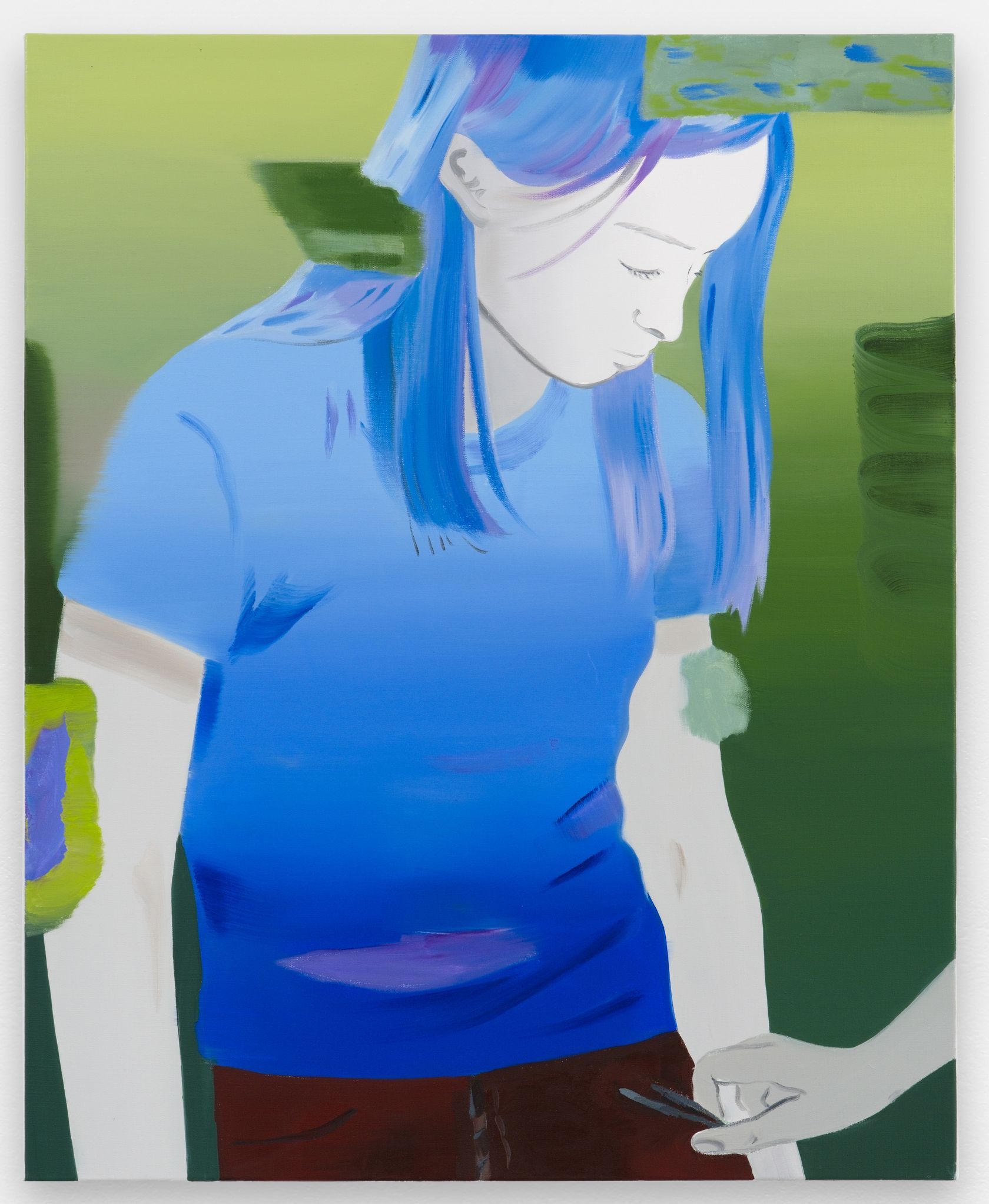
Let us begin with the motif of hair, with its coloured lines, elongated and interrupted, which almost form a world of their own. They create a screen of colour around a face that seems, in turn, to disappear. In Tenir (2026), this disappearance is heightened by the young girl’s very posture, her eyes fixed on the floor. Her face is left in reserve, marked by modesty, acting as an interface between two areas of colour—the T-shirt and the hair—that condense the drama of presence. It is in this double movement—modesty and withdrawal on the one hand, chromatic intensity on the other—that Françoise Pétrovitch’s painting gives expression to the condition of adolescence: its uncertainties, its inwardness paradoxically made visible. And yet, what might be understood as narrative is in no way the subject of her painting. “I never think about the image through the mechanisms of narrative,” the artist explains. “Through painting, I try to create a space in which transformations are possible, a place to accommodate what is still becoming.” Transformation, then, in the plural: something the artist experiences through contact with clay, supple and yielding, responding immediately to the hand. In conversation, she told me that “the hand is no different from the brush: it carries something of myself”. In the ceramics, the drawing of hair seems to metamorphose into skin, fur or a vein. The line leaves the surface of the canvas to enter the thickness of the earth. Each groove shaped by the hand receives a predominantly blue-green colour, carrying with it an entire imaginary world.
“Unreal.” This is how Françoise Pétrovitch describes the colours of the glazes she has created. Over time, her palette of peacock blue, teal and celadon has become her signature, yet these colours resist their own naming. “With glaze, I found again the changing colours I have always sought in washes and painting—colours that are difficult to define; you don’t know whether you are looking at grey, blue, or green…”
Like the states she depicts, these hues inhabit an in-between: a disquieting coexistence in which the light of peacock blue seeps into milky green, as in Tenir (2024). Others, such as Cerf (“Deer”, 2024), embrace a more seemingly unequivocal colour, close to a deep turquoise, punctuated by patches of milky white adorning the tips of the antlers. Yet here, as in the other ceramics, the glaze remains mutable, and the journey through colour continues.
Among the pictorial motifs that pour into the sculpture, several are rooted in gesture or action. “Holding” (tenir) is perhaps the most elementary. It is this gesture that unites the two adolescents in Sans Titre (2026), introducing an element that tells the story of adolescence as much as clothing or hair. Grasping a phone may seem entirely commonplace. Even so, in a painting devoid of scenery, the close attention paid to a single action (holding a phone and being consumed by it) carries the full psychological weight of the portrait. The artist describes observing young people in museums or in the street: “Their hands are always full of objects. Transitional objects behind which they take refuge, phones that keep them occupied and come between them. These adolescents rarely look at one another, rarely speak to one another, but they touch, almost merge. Their identities fuse within intense friendships in which each becomes the mirror of the other.”
And when it is not a phone, what are these young people holding? In the painting Tenir (2026), described above, it seems to be a pocket. In the ceramic sculpture Tenir, the young boy clings to an animal. His body is almost entirely absorbed into the animal’s, in a gesture that is at once an embrace and a refuge. They share the same colour, the same unreal world, but also the same absence from themselves: their eyes are unfocused, their mouths barely articulated. The ceramics depicting masks follow the same logic. The child holds up a surface in order to hide behind it, just as the young boy becomes one with the animal he embraces. Thus, in Françoise Pétrovitch’s work, holding something always seems to contain its opposite: holding on to something in order to withdraw from the world.
This new exhibition also appears to follow a principle of contamination. First, between painting and sculpture, but also within painting itself. In her new series of canvases, the figures are unsettled by an agitated background. Areas of flat colour are interrupted by the surprising appearance of “paint remnants.” In Sans Teint (2026), both background and figure are overlaid by these autonomous strips of paint, which disrupt the planes. The figure is no longer isolated, as in the painting of the two adolescents described above. Here, the adolescent is permeated by her surroundings. This contamination also speaks to age—not the biological or sociological age of which one might say that Françoise Pétrovitch depicts the symptoms. Here, age has broken free from the hinges of linear time to become a principle of echo and overflow. When she finishes a painting, the artist “wipes” her brush onto a blank canvas destined to receive the next one. This “paint remnant” is the trace of a memory, of a gesture repeated. Through it, a genealogy is formed through contact, a way of “making family” differently, since each painting contains within itself a fragment of the one that preceded it.
In the ceramic process, transformation happens through chemistry: under the effect of intense heat, the clay hardens and the glazes unfold into deep, vitreous colours. Small in scale, each sculpture invites a sense of inwardness and concentration that demands a choreography within the space. Thus, across the exhibition as a whole, a family of plinths, animals and gestures of affection takes shape, each containing its own worlds: worlds of colour, contaminated and transformed.
Julia Marchand