The Royal Abbey of Fontevraud, a stone vessel composed of exceptional volumes with monumental proportions, stands as one of the most remarkable architectural creations in the Val de Loire.
With À toute volée, the Royal Abbey of Fontevraud is acquiring new bells to restore a sound identity worthy of the full set of bells that once marked the daily life of the monastery.
Each year, a new bell is cast, and its decoration is created by an artist.
These bells are primarily musical instruments. Born at the Cornille Havard foundry in Normandy, each bell produces a note unique to itself.
The fine bronze bells are displayed in the abbey gardens, allowing the public to see them up close, touch them, and even ring them manually, providing a sense of their scale and acoustic presence.
Thanks to this exceptional loan, Le Voyage en hiver presents them in the moats of the Château des Ducs de Bretagne. They will be activated through the sound score by Dominique Blais, À flot d’airain.
New for 2025: Robert by Françoise Pétrovitch
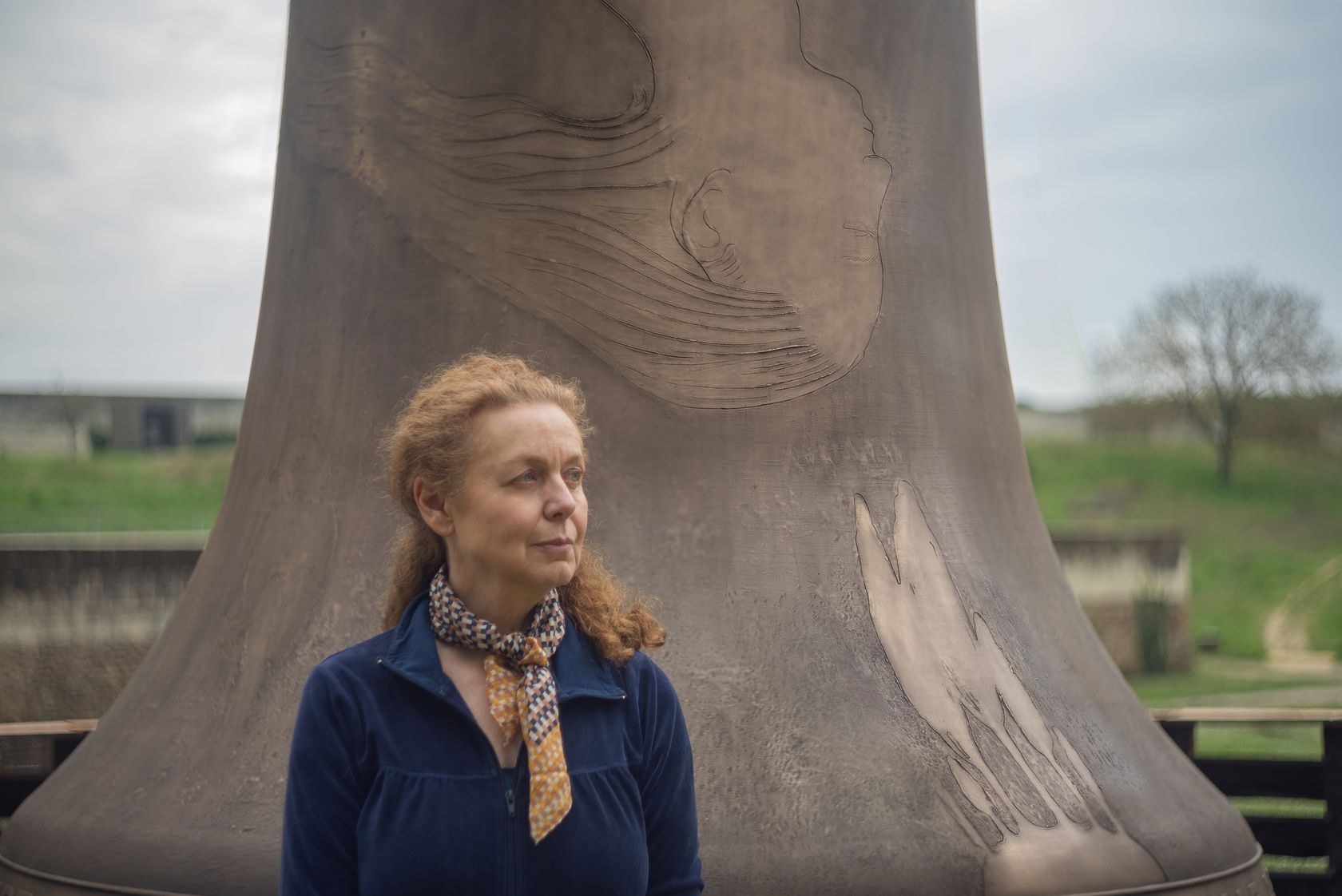
For the decoration of the bourdon—the largest bell in a set—the design was entrusted to Françoise Pétrovitch, inspired by Robert of Arbrissel (1047–1117), founder of the Royal Abbey of Fontevraud in 1101.
Imposing in size, standing two meters high and weighing 4.8 tons, this bell produces a deep and powerful sound, resonating through the space with majestic intensity. Using the technique of intaglio engraving, Françoise Pétrovitch chose to work on large motifs to preserve the monumental character of the bell. Inspired by the life of Robert of Arbrissel, a man who embodied ideals of freedom and renewal, every line and curve drawn by the artist seems imbued with breath, inviting contemplation of a frozen movement captured in matter. Through her precise and delicate gesture, the artist captures this incessant flow, this movement that never ceases—a reflection of a life in perpetual transformation that still resonates today.
Three figures in profile—Robert and two abbesses—intersect without meeting. One of the women is upside down, her hair streaming, evoking a vision of the heavens and the earth reversed. The sense of movement is also conveyed through non-illusionistic space, where nature—trees, birds—is ever-present in the medieval imagination, represented in a stylized manner, with the profile figures arranged symbolically in layers.