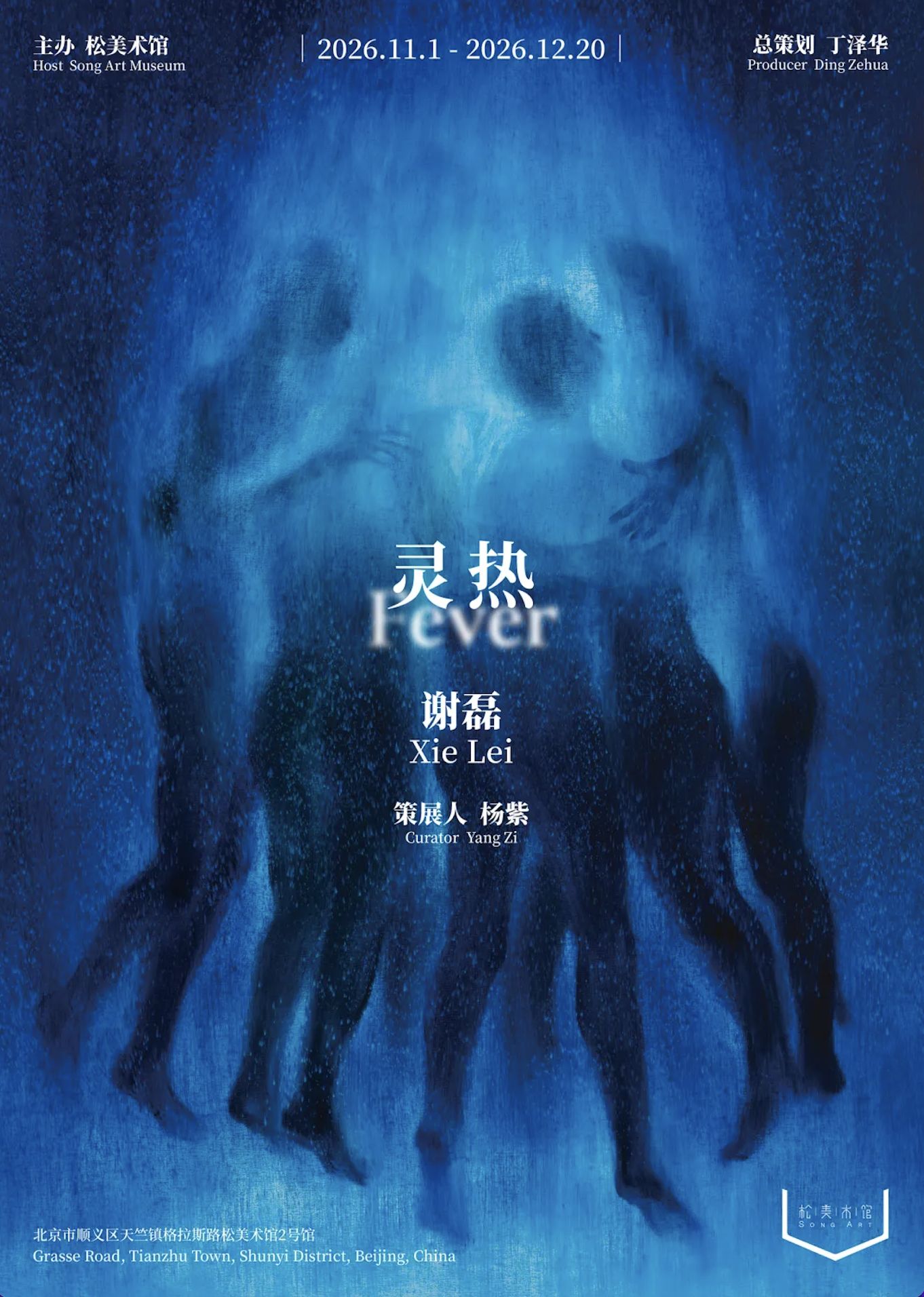
On November 1st, 2026, Song Art Museum will present the solo exhibition "Fever" by artist Xie Lei. This is the artist's first solo exhibition in China since winning the Marcel Duchamp Prize in 2025. The exhibition is curated by Yang Zi. Over the years, Song Art Museum has been focusing on the contemporary art trends shaped by different generations and regional experiences. This exhibition continues the museum's focus on contemporary artists in a cross-cultural context.
The Secret Rituals of Painting
The exhibition showcases ten works, nine of which are large-scale paintings nearly the same height as a human being. Yang Zi uses "the secret rituals of painting" as a thread to direct focus toward the constantly occurring relationships between the body postures in the paintings: The bodies in the paintings present postures of mutual support, pulling, compression, attachment or entanglement. The movements sometimes approach conflict, and sometimes have a collective quality like dance and ritual. These works do not attempt to tell a complete story, but shift the focus from "who the figures are" to "what is happening between the bodies". "Secret rituals" is closer to a relationship between a body image and an image in art history—when an individual enters a highly concentrated collective experience, the originally clear identity, order and boundaries begin to loosen, and the energy between the bodies is transferred, gradually generating a whole that transcends a single individual.
Control, Exchange, and Recomposition
In Xie Lei's creations, the concepts of control and being controlled, giving and receiving, desire and resistance do not have fixed positions. Instead, they constantly shift as a result of physical contact. The figures in his works do not have distinct faces, and their identities are intentionally weakened. As a result, the body no longer primarily points to a specific person but becomes a site where emotions, power, and relationships occur. At the same time, Xie Lei constantly searches for corresponding body postures from different historical images—from the ritualistic body images in ancient paintings to the religious body images in classical art, from the dynamic bodily movements in Baroque and Romanticism to accidentally captured gestures in daily life—all of which may break away from their original narratives and be recombined into the artist's works. In Xie Lei's paintings, the body is like a continuously flowing memory bank of images, re-establishing connections with bodies from different eras.
The Moment of Continuity
From a deeper perspective, the repeatedly depicted bodies in Xie Lei's works always point to the complex and delicate relationships between the individual and others. Life relies on boundaries to sustain itself, yet it also constantly desires to go beyond itself and establish deeper connections with others. Yang Zi uses Bataille's concepts of "expenditure" and "continuity" to explain the "continuity" in the artist's works: when the originally clear boundaries temporarily loosen, individuals may form a common state that transcends the everyday order. The paintings by Xie Lei capture precisely these fleeting and intense moments: bodies approach, entangle, and exchange energy, and independent individuals are constantly redefined through mutual interaction. Thus, the paintings not only record the form of the body but also preserve the intangible connections between people. When the boundaries that sustain the self are temporarily opened, do we lose our original completeness, or do we gain another possibility of reaching others?