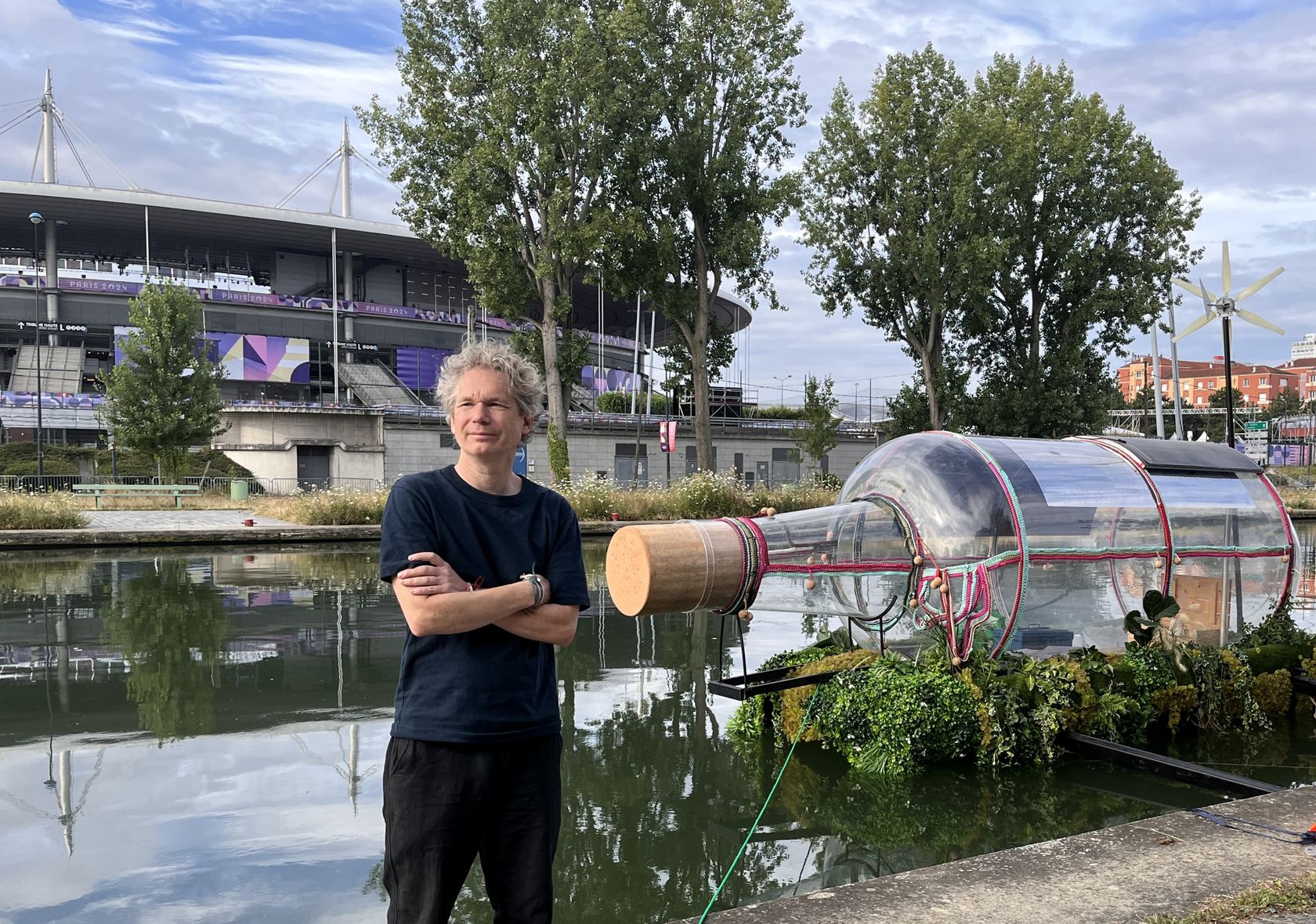
La Bouteille, a project by Abraham Poincheval commissioned by Plaine Commune and supported by cneai = in association with Ilotopie, is 580 centimetres long and 190 centimetres in diameter. This summer, it will become a real vessel, as it will be floated and inhabited by the artist on the Canal Saint-Denis for the first time, at the time of the Paris 2024 Olympic Games.
At the opening of the Paris Olympic Games, Abraham Poincheval will be offering a performance to canal-goers, passers-by, as well as fans and tourists visiting the Stade de France. For two weeks, from July 25 to August 7, 2024, the artist will inhabit the inside of the bottle in a performance of which he has the secret. Accustomed to extreme practices, Abraham Poincheval echoes notions of confinement, isolation and immobility, opening himself up to meditative journeys and questioning the resilience of bodies and their environmental interactions.
The chosen location echoes history: during the siege of Paris in the Franco-Prussian War of 1870, while the Canal Saint-Denis was still under construction, the besieged inserted messages into tin balls designed to float between two waters and cross opposing lines. In this way, the place gives the object a sense of entity: “an enlarged object that looks as if it had been abandoned by a giant”, the bottle disrupts the landscape by inviting its share of the imaginary. An object of narrative and fiction, it offers a narrative for which the passer-by, astonished, becomes a spectator and stops for a moment.
The theme of the bottle in the sea symbolizes a journey through time and space, through winds and currents, to deliver a message. Whether the story of the bottle in the sea is imaginary or real, it offers us a reading of the society it crosses, just as the Olympic Games seem to crystallize in a punctum the essence of an era, a civilization, a city, a geopolitics. Thus bottled up, Abraham Poincheval surrounds himself with the bare essentials of life - water, food, first-aid kits and conveniences - and a plant ecosystem that turns the cabin into a garden, a greenhouse, a bedroom, a kitchen, a living room, a dining room and a dry toilet. He recreates the conditions of a possible, singular and rudimentary life. The experience of La Bouteille takes up notions of performance and endurance to question them: in a fast-paced society with intensified lifestyles, isn’t immobility a remarkable effort, a potentially political object, a performance of self-denial or self-mastery?