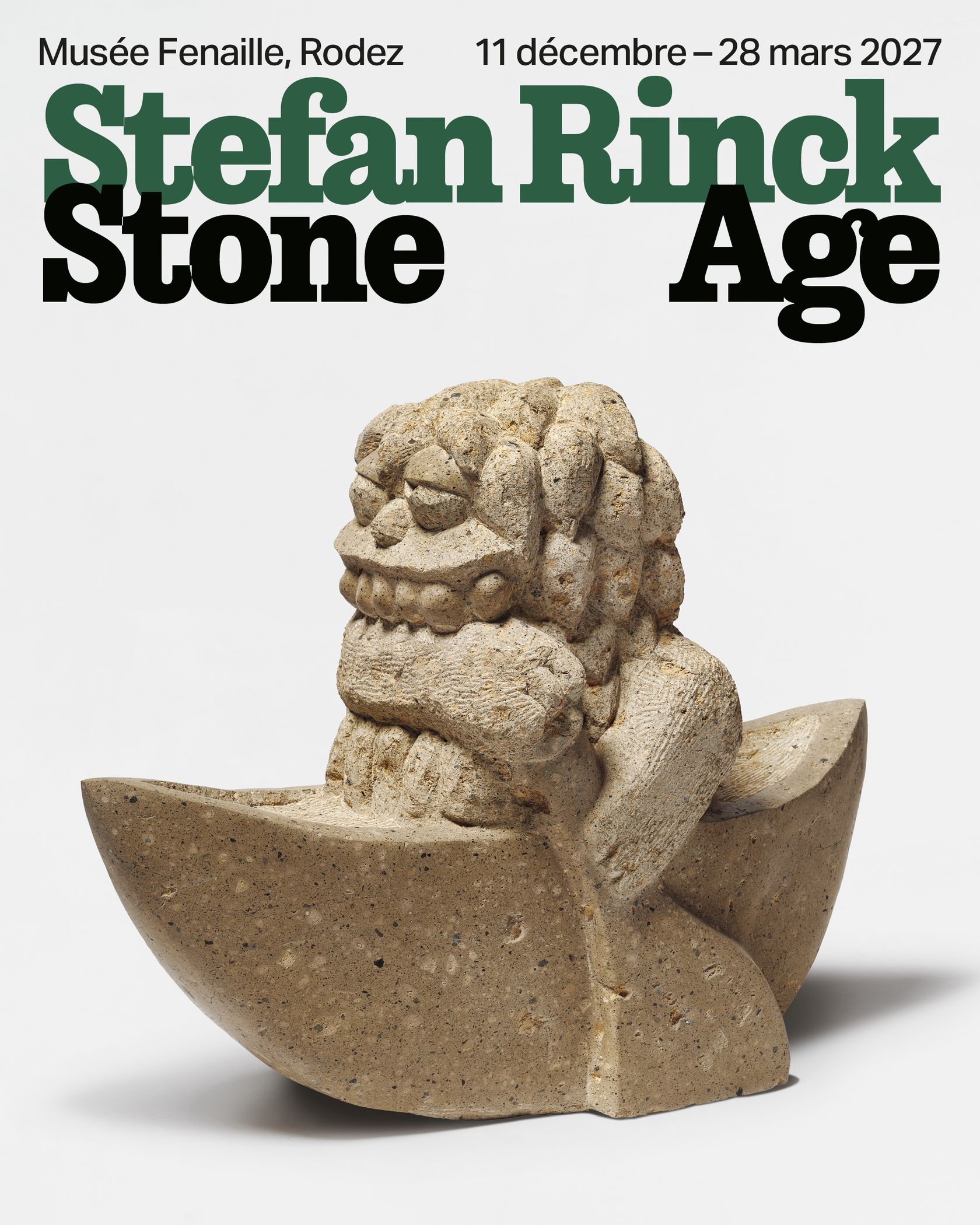
Beginning in December 2026, around fifty works by the German Artist Stephan Rinck will be exhibited at the Musée Fenaille, engaging in a dialogue with the museum’s magnificent collections. With sculpture at the heart of its museography and over 1,100 works on display, the Musée Fenaille offers an ideal setting for the oeuvre of Stefan Rinck. This encounter promises a thought-provoking exchange centred around stone, between Rinck’s contemporary works and the more ancient treasures from the Aveyron region conserved at the museum. Prehistoric tools, Neolithic standing stones, Gallo-Roman sculptures and carved architectonic fragments form a collection of exceptional objects that bear witness to humankind’s artistic inventiveness, which visitors will be encouraged to rediscover from the perspective of a 21st century artist.
With his rare technical mastery of the direct carving of stone and his deft handling of a wide variety of iconographic symbols and references, Stefan Rinck has become a unique figure in contemporary sculpture. Capitalizing on his encyclopaedic knowledge of forms, he breathes new life into historical motifs, adapting them to the contemporary era. His sculpted figures interweave narratives of diverse origins in a secular syncretism, which blends Romanesque art with Aztec influences and where a Romantic reinterpretation of Gothic design merges with the influence of Pop culture. Stephan Rinck’s show at the Musée Fenaille showcases several of his favourite subjects: crocodiles; slightly ominous figures with bulging eyes and predatory grins; masks and quirky costumes, such as that of the harlequin; and lastly, tufts of hair, furry fleeces and armour made of scales. This broad selection of sculptures demonstrates the scope of his repertoire and shows off the variety of ways he works different surfaces—some being polished to produce a mirror-like finish, while others are left raw and rough, bearing the marks of the sculptor’s chisel in all manner of stone: marble, tuffeau limestone, diabase, onyx, sandstone and blue granite.
Stefan Rinck is well versed in the semantics of figurative representation that he employs on many different levels. There is however invariably a common denominator: sarcastic and scathing humour. His sculptures also take advantage of the dichotomy between the elegance of his symbols’ language and the raw power of the stone; between the delicacy of a line or an expression, taken from a drawing executed on the fly, and the long and patient work of carving, to which the artist devotes himself with evident pleasure. The real tour de force of these sculptures however, is his ability to translate with apparent simplicity, a caustic and vibrant energy from the inertia of stone.
A recurring stylistic device in Stefan Rinck’s work is the personification of animals, such as a vaguely human body, topped off with an animal’s head and displaying grotesque proportions, while standing firmly on two legs with hoofed feet. These effects are always potent, as humans often recognizes themselves more clearly in the form of caricatured animals than in their own fellow beings.
The unique and greatest collection of menhirs in Europe, preserved by the Musée Fenaille, serves as a visually stimulating counterpoint to Stefan Rinck’s sculptures. These menhirs with their anthropomorphic forms, erected around three thousand years ago are the oldest large-scale representations of humans in Western Europe. The Dame de Saint-Sernin, a medium sized (113 cm tall by 56 cm wide), stylized, prehistoric icon, with her hands folded across her chest, bears a striking stylistic resemblance to the Apotropäischer Hausfreund (2025) whose face is chiselled rather than carved out from the block, or with Rhombus (2025) and Fat Bubu (2025), which also exhibit the barely sketched outline of arms folded across their upper bodies.
In the conclusion of Bazon Brock’s 2016 essay on Stefan Rinck, we find the following dizzying statement: “In everything produced by contemporary artists, we discover the same spiritual and intellectual developments as those that were manifested in the Lascaux caves or on Easter Island. This essentially means that each work traverses the history of artistic production of a thousand generations.” This assertion is easily verified through the comparison of Stephan Rinck’s works with these ancient sculptures. At the merest glance, it is clear that all these sculptures come from very far, not only in terms of immemorial geological ages, but also from ancient and universal myths.